[ad_1]
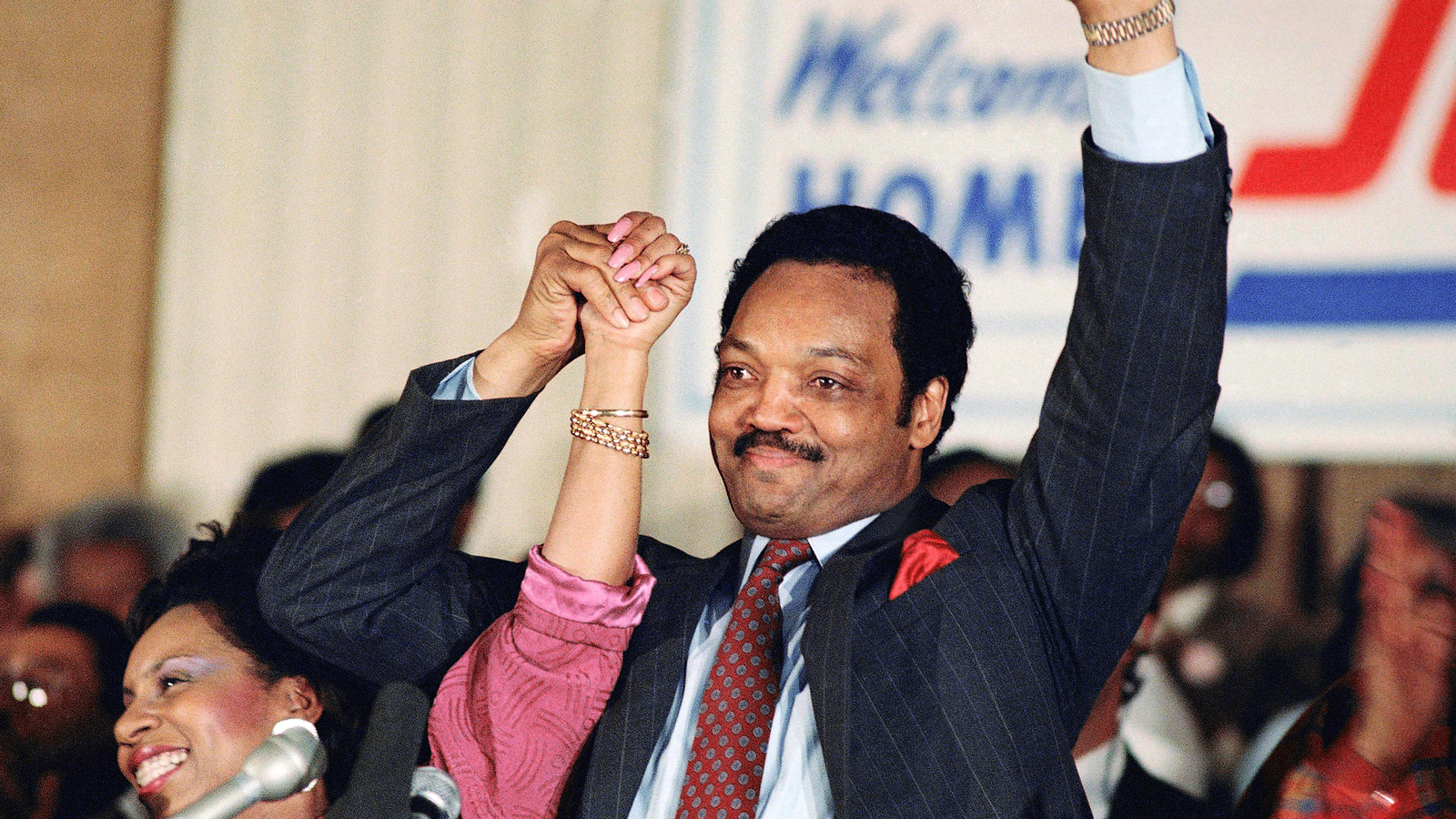
Civil rights icons, politicians and thought leaders across the United States shared tributes reflecting on the legacy of the late Rev. Jesse Jackson, the pioneering civil rights leader, Baptist minister and politician who died on Tuesday morning at the age of 84.
President Donald Trump remembered Jackson as “a good man” and “force of nature,” while former President Bill Clinton, in a joint statement with former presidential candidate Hillary Clinton, reflected on how Jackson “championed human dignity” and said he was “honored” to present him with the Presidential Medal of Freedom in 2000 as president.
Jackson, who launched two bids for the U.S. presidency in 1984 and 1988, was a protégé of civil rights leader Dr. Martin Luther King Jr., and dedicated his career to advancing economic justice and building political power for Black Americans.
Former President Barack Obama, in a joint statement with former first lady Michelle Obama, paid tribute to Jackson and wrote that the civil rights leader “helped lead some of the most significant movements for change in human history” and credited Jackson’s own presidential campaigns for making it possible for Obama to become the first Black president in the U.S.
“Reverend Jackson also created opportunities for generations of African Americans and inspired countless more, including us. Michelle got her first glimpse of political organizing at the Jacksons’ kitchen table when she was a teenager. And in his two historic runs for president, he laid the foundation for my own campaign to the highest office of the land,” the statement said. “Michelle and I will always be grateful for Jesse’s lifetime of service, and the friendship our families share. We stood on his shoulders.”
King’s son, Martin Luther King III, shared a joint statement with his wife Arndrea Waters King, describing Jackson as a “a towering voice and a devoted servant of justice.”
“Reverend Jackson was more than a civil rights advocate. He was a living bridge between generations carrying forward the unfinished work and sacred promise of the civil rights movement,” the statement from the Kings said. “He walked with courage when the road was uncertain, spoke with conviction when the truth was inconvenient, and stood with the poor, the marginalized and the forgotten when it was not popular to do so.”
Jackson was tapped in 1966 by Dr. King to lead the Chicago chapter of the Southern Christian Leadership Conference’s Operation Breadbasket an initiative that utilized boycotts known as “selective patronage” to support Black-owned businesses and pressure white-owned businesses into hiring African Americans, according to The Martin Luther King, Jr. Research and Education Institute at Stanford University.
According to the institute, the Chicago-based chapter of Operation Breadbasket became a cultural event that drew thousands each week to hear Jackson preach in person and on the radio. Jackson became the national director of Operation Breadbasket in 1967 and later founded his own civil rights organization, Rainbow PUSH Coalition.
Rev. Al Sharpton, a fellow civil rights leader and minister who considers Jackson a “mentor,” recounted during a press conference on Tuesday morning how he first met Jackson as a 12-year-old when Jackson appointed Sharpton as youth director of Operation Breadbasket.
“He was the one who was more responsible than anyone for teaching me activism on a personal level,” Sharpton said. While speaking with reporters on Tuesday about what he learned from Jackson, Sharpton invoked the late reverend’s slogan, “I am somebody,” which Jackson famously recited in a 1971 call-and-response chant with children on Sesame Street.
“I am somebody. I may be young. But I am somebody. I may be on welfare. But I am somebody. I may be small, but I am somebody,” Jackson said, in part, as the children repeated after him. “I may make a mistake, but I am somebody. My clothes are different, my face is different, my hair is different, but I am somebody.”
Sharpton, who grew up on welfare in the public housing projects of the Brownsville neighborhood in Brooklyn, New York, said that Jackson, who was born on Oct. 8, 1941, in Greenville, South Carolina, made him believe that he could be “somebody.” “Jesse was born out of wedlock. He taught me his slogan was, ‘I am somebody.’ It’s not how you’re born, it’s where you go with it,” Sharpton said. “So he made me believe, even a kid on welfare in Brownsville, Brooklyn could be somebody.”
Civil rights attorney Ben Crump, who was a fraternity brother and friend of Jackson, partnered with him over the past decade to bring attention and justice to the stories of unarmed Black Americans who were killed by the police like George Floyd and Breonna Taylor.
“Because of Reverend Jackson, there is a broader path in American politics and public life for leaders of color. Because of Reverend Jackson, millions were empowered to say, ‘I am somebody,'” Crump said in a statement on Tuesday morning. “His legacy is woven into every advancement in voting rights, economic justice, and civil rights over the last half-century.”
Meanwhile, Chicago Mayor Brandon Johnson, who also considered Jackson a “mentor,” said in a statement on Tuesday morning that the flag of the city of Chicago will fly at half-staff to honor Jackson.
“Rev. Jackson held strong to this truth that we all are ‘somebody,'” Johnson said. “He preached that the flame of hope exists in all of us and it is our power and responsibility to unify that flame amongst our neighbors to improve our present conditions and secure a future where we can all thrive.”
Copyright © 2026 ABC News Internet Ventures.
[ad_2]
Source link