[ad_1]

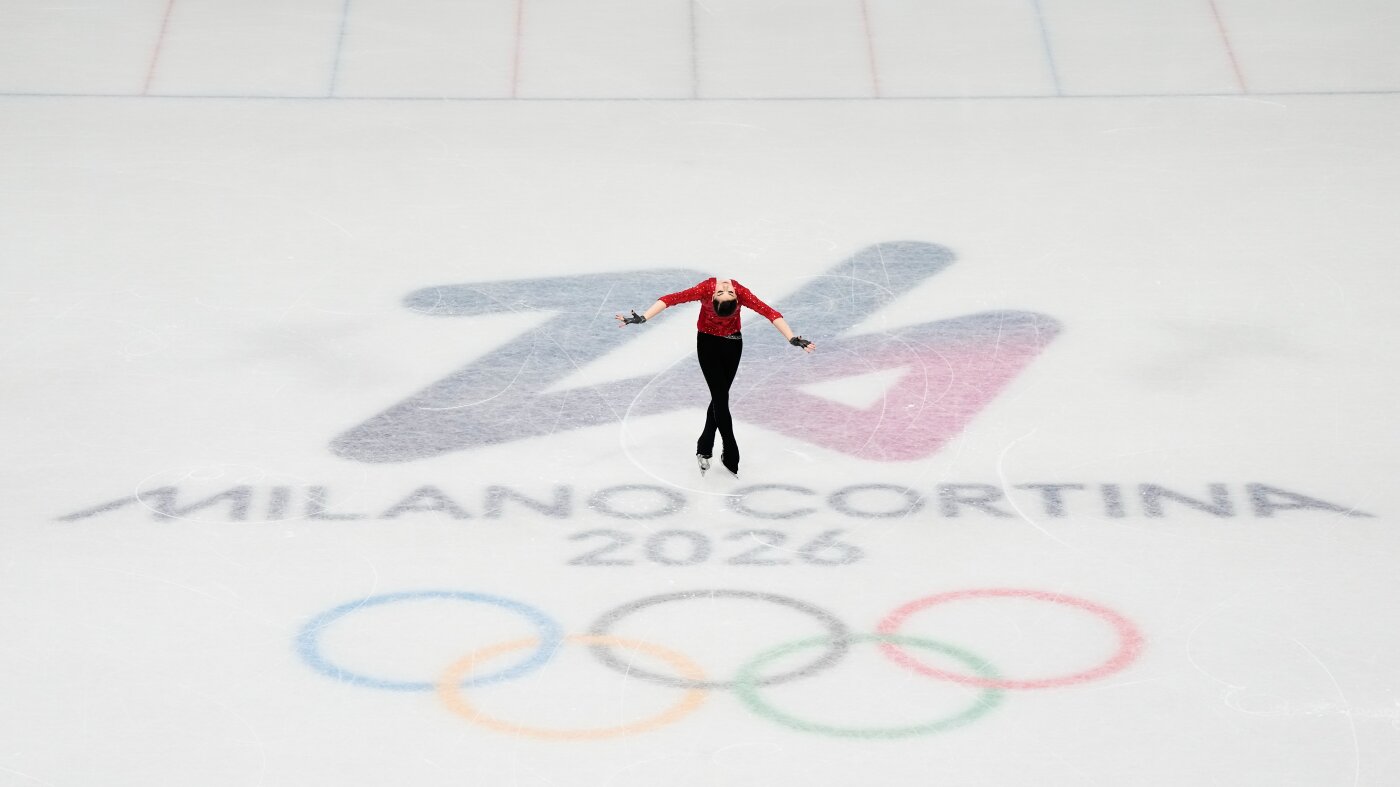
Adeliia Petrosian of Individual Neutral Athletes competes during the women’s figure skating short program at the Winter Olympics in Milan on Feb. 17.
Ashley Landis/AP
hide caption
toggle caption
Ashley Landis/AP
Nearly 3,000 athletes have faced the icy rinks and snowy ramps in Italy for the Milan Cortina Winter Olympics.
The Olympic Games are host to rare athleticism and national pride. So before we bid the Games adieu in just a few short days, let’s commemorate the “Olympics” for this iteration of NPR’s Word of the Week.
Where the word comes from
The word “Olympics” is rooted in ancient Greece.
In Greek mythology, the gods would descend from Mount Olympus into the town of Olympia to gather and socialize with humans, according to Matthew Llewellyn, co-director of the Center for Sociocultural Sport and Olympic Research at California State University, Fullerton.

“Olympia itself was kind of a sacred space,” he said. “It was a sanctuary.”

Mount Olympus is seen from the port of Thessaloniki in Greece on April 2, 2015.
Sakis Mitrolidis/AFP via Getty Images
hide caption
toggle caption
Sakis Mitrolidis/AFP via Getty Images
The first ancient Olympic Games began sometime around 776 B.C.E., Llewellyn said. Back then, athletes competed naked, track stars received corporal punishment for false starts, and there were no gold medals — only silver and bronze, according to the International Olympic Committee’s website.
But after about 1,000 years of these games, the competition, along with the word, was lost during the Dark Ages, or the aftermath of the fall of the Roman Empire.
Like the flame of the Olympic torch, however, interest in ancient Greece and the Olympics was reignited during Europe’s Renaissance era. People had begun reading about the ancient Olympics and conducting archaeological excavations of Olympia, Llewellyn said.
“Around that time period, late 1500s, early 1600s, we see a number of sporting contests that go by the name ‘Olympic Games,'” Llewellyn said. “And this would be Olympic with a ‘c,’ sometimes Olympick with a ‘k.'”
For example, the Cotswold Olimpick Games in England have been happening since 1612 and are still going strong, with events like tug-of-war and shin-kicking. The Zappas Olympics were held a few times in Greece in the late 1800s, sponsored by businessman Evangelis Zappas.
How we got to the modern Olympic Games is contentious.
“Academics are in fierce argument over this topic,” Llewellyn said.

Some historians say Zappas petitioned Greece’s King Otto for a revival of the games in 1856 and offered to pay for them. Other historians, as well as the International Olympic Committee, credit French aristocrat Pierre de Coubertin with proposing the revival in 1894. The first modern Olympic Games were held in Athens, Greece, in 1896.

A monument in honor of Pierre de Coubertin, widely credited with founding the modern Olympic Games, stands outside the New National Stadium in Tokyo on Jan. 21, 2020
Clive Rose/Getty Images
hide caption
toggle caption
Clive Rose/Getty Images
There are also arguments over who gets legal rights to the word, Llewellyn said.
In 2021, the U.S. Olympic & Paralympic Committee sued Puma, claiming the company was infringing on the committee’s trademarks by filing trademarks for “PUMA TOKYO 2021” and “PUMA PARIS 2024.” In 2024, the committee sued influencer Logan Paul’s energy drink company, Prime Hydration, claiming it illegally used Olympic trademarks in advertisements. Both suits were dismissed.
“It’s an egregious overreach, I think, because I don’t think you can own a word,” Llewellyn said. “And you certainly can’t own a word that was first used thousands of years ago by the Greeks.”
NPR has reached out to the International Olympic Committee and the U.S. Olympic & Paralympic Committee for comment on the lawsuits but has not heard back.
What “Olympics” means to an Olympian
When four-time Olympian Ashley McKenzie was 11 years old, he got into a scuffle over a Pokémon card.
During this particular fight, McKenzie’s opponent caught him off guard by throwing him a certain way. It was a judo move, he would learn. McKenzie hightailed it to the nearest judo studio to find the kid and get his card back.

Ashley McKenzie of Great Britain poses for a photo to mark the official announcement of the judo team selected to Team GB for the Tokyo Olympic Games, on July 5, 2021.
Barrington Coombs/Getty Images
hide caption
toggle caption
Barrington Coombs/Getty Images
The coach there wanted McKenzie to try out judo for himself. Hearing “Olympics” reeled him in.

“The word ‘Olympics’ to me, it opened my eyes to new doors and new things,” McKenzie told NPR. “When I first heard it, it gave me hope.”
Ten years after that encounter, he represented Great Britain on the Olympic stage at the 2012 London Games.
“When I got there, it didn’t matter what I looked like,” he said. “It didn’t matter what I was doing or how I acted. Everyone, the whole country, got behind me, and that’s when I knew it was so nice to be an Olympian.”
[ad_2]
Source link