[ad_1]
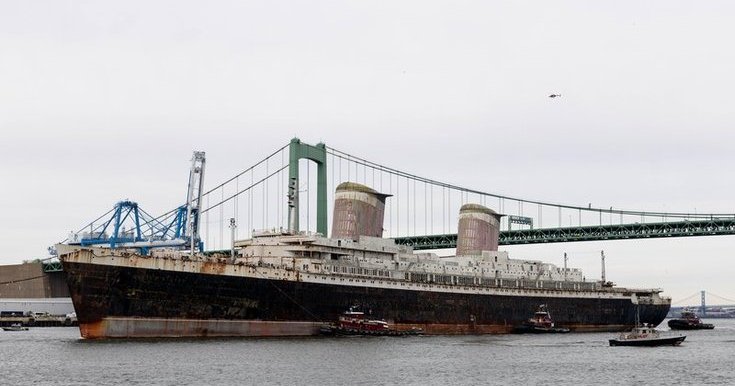
Plans to turn the SS United States into the world’s largest artificial reef have been fought by preservation groups ever since the ocean liner — long docked in Philadelphia — was sold in 2024 to create a diving destination off the Florida Gulf Coast.
Okaloosa County, which purchased the vessel from the SS United States Conservancy, hopes to sink the historic ship as soon as April, officials say. But the county’s plan now faces another challenge from parties who hope to keep the vessel afloat.
MORE: Developer gets $150 million loan to build 36-story apartment tower along the Delaware River
This time, preservationists point to warnings from environmental scientists, who say the SS United States is coated in a toxic primer — zinc chromate — that will pollute the Gulf of Mexico and its food supply for decades without further remediation to remove it.
Famed environmental activist Erin Brockovich, whose groundbreaking 1993 legal case against Pacific Gas & Electric involved the presence of the same chemical compound in California groundwater, recently threw her support behind the effort to expose potential hazards of reefing the SS United States.
“Clean your ship up before you sink her … or be stupid, do it, harm thousands, and spend hundreds of millions cleaning up your crap for the next twenty years,” Brockovich wrote in a Feb. 18 Facebook post.
Okaloosa County’s reefing plan is still under review by the U.S. Army Corps of Engineers. Preservationists contend the project is not a done deal. Even though a federal lawsuit from the New York Coalition to Save the SS United States was dismissed by a judge in August, there is still another lever that could stall the ship’s sinking.
The SS United States, best known for setting the transatlantic speed record on her maiden voyage in 1952, was deemed to have “compelling national significance” when it was added to the National Register of Historic Places in 1999. Under the National Historic Preservation Act, qualified parties are able to participate in a federal review that evaluates the reefing plan and considers suitable alternatives.
“They cannot get final approval without the Army Corps decision,” said Carlos Camacho Jr., co-founder of the SS United States Preservation Foundation, whose members say the environmental risk is serious enough to save the ship from reefing and display it elsewhere.
Toxic reef could become a ‘financial noose’
Concerns about zinc chromate on the SS United States surfaced in testimony given to Okaloosa County officials in September. More testimony was provided to the Army Corps last month during the agency’s federal review.
Zinc chromate, widely used in the 1930s and ’40s to prevent corrosion, contains hexavalent chromium that would only become an environmental threat if the ship is submerged. The hull of the SS United States was primed with a different formula used to prevent the growth of organic matter, making it safe to sit in the water during the years the ship was kept in the Delaware River.
The rest of the ship, inside and out, contains more than 1 million square feet of zinc chromate coating. The heavy metal is water soluble, meaning it can travel easily and stick around as it degrades. The National Institutes of Health and U.S. Environmental Protection Agency both classify zinc chromate as a known human carcinogen, and it is now used more sparingly in favor of other industrial-grade primers.
“If this ship is sunk, it will not simply disappear beneath the waves,” said Justin Hruby, a member of the preservation foundation. “Instead, the toxic coatings will begin to leach into the marine environment immediately.”
Todd Osborne, a biogeochemist at the University of Florida, gave testimony and a report to the Army Corps in January explaining the risks of hexavalent chromium — calling it “one of the worst” known sources of heavy metal toxicity. Osborne said the chemical could enter the food stream, threaten fisheries in the gulf, expose people to cancer risks and become a major liability for the government.
“That could be a financial noose that would be crippling for a long time,” Osborne said.
Okaloosa County officials say their $10.1 million reefing project is compliant with all standards set by the EPA and other regulatory agencies. The county has reefed 48 other vessels since the 1970s and notes hundreds of others that have been sunken to become dive sites in the gulf.
“Artificial reefs prepared in this way are a benefit to the marine ecosystem, not the other way around,” Okaloosa County spokesperson Nick Tomecek said. “They create habitat that did not previously exist and foster the development of a diverse environment that can thrive.”
Tomecek declined to say whether any of its other reefed ships contain zinc chromate.
Drexel University professor David Velinsky, an expert in chemical oceanography, said the toxicity of zinc chromate leeching into the gulf depends on how it degrades when oxidized in sea water. Osborne and Brockovich contend it will spread hexavalent chromium thats’s already in the primer, but the county claims the compound’s use on metal will cause it to convert underwater into the less potent trivalent chromium.
“The (trivalent chromium) is not toxic, or it’s a lot less toxic,” Velinksy said. “It’s unknown. If you want to be totally risk free, then you wouldn’t do it, right? I think (the risk is) a little overblown. That’s my gut. …I’d rather not see it, and if there’s a way of mitigating and they’re cleaning up the ship, maybe that’s one thing they should be doing.”
A push for federal government to get involved
Since leaving Philadelphia one year ago, the SS United States has been docked in Mobile, Alabama, to undergo remediation before reefing, and its 65-foot-tall smoke stacks have been removed for use at a future museum. In December, Okaloosa County officials said work to prepare the ship for sinking was 80% done.
Coleen Marine, the company contracted to clean and ready the SS United States for divers, has focused on requirements to remove polychlorinated biphenyls (PCBs) found in tests of the ship’s materials. Removing PCBs is part of the EPA’s guidance, but the agency does not require removal of zinc chromate.
Tim Mullane, founder of Coleen Marine, said yellow patches of zinc chromate are visible on the parts of the SS United States, but the county does not plan to have it removed.
“I’m not a chemist, but I do know that nobody involved in this project would ever want to do anything that’s going to harm the environment,” Mullane said. “I don’t see the need to remove it. If there was truly a need to, it would be happening.”
Mullane said he respects preservationists’ devotion to the SS United States, but questions the litany of reasons they have given to stop the reefing project in favor of vague, last-minute alternatives.
Despite years of opportunity to come up with money and a viable plan to save the ship, the SS United States Preservation Foundation claims efforts to do so were often misguided. They focused too much on turning the SS United States into a “cash cow” instead of emphasizing its value as a display piece.
“We’re talking about a static attraction, much like you see with the Statue of Liberty, for example, or like the Battleship New Jersey,” Camacho said.
During the federal review, which is closed to the public, the preservation foundation suggested the U.S. government give Okaloosa County a different ship to reef. The government could then take ownership of the SS United States to use as a public monument at a federally owned berthing.
The Army Corps’ review may continue for weeks or months before Okaloosa County gets final approval to reef the ship. Camacho estimates that if the county were to fully remediate the zinc chromate on the SS United States, the budget could swell upwards of $50 million and become financially impractical.
“It’s not a good vessel to use, nor is it good for optics,” Camacho said. “Even during America 250, to have a vessel that literally bears our name on the side of it, it’s a nationally registered property, and you sink it with environmental toxins on board. I mean, that alone will be devastating for the United States.”
[ad_2]
Source link