[ad_1]
Americans are paying more for gas as the U.S.-Israeli war with Iran chokes off a significant route for roughly one-fifth of the world’s petroleum products.
Global prices for Brent crude oil, the international standard, climbed over $100 a barrel. Prices were just above $70 a barrel in the days before the United States and Israel launched a surprise Feb. 28 attack on Iran, killing the regime’s top leader and other powerful government figures.
MORE: Villanova history professor explains shifts of U.S.-Iran relations from Eisenhower to Trump
The spike, which peaked at $119.50 per barrel early Monday, caused ricochets throughout markets, with major stock indexes falling worldwide. Oil prices have not reached costs above $100 per barrel since mid-2022 after Russia launched its full-scale invasion in Ukraine.
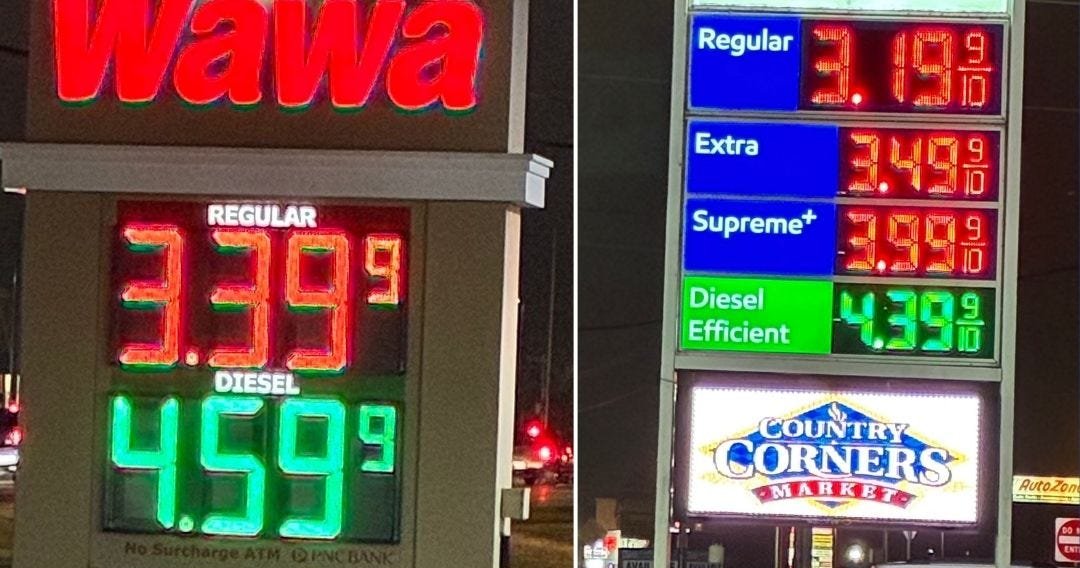
In Pennsylvania, the average price for a gallon of regular gas was $3.59 as of Monday, according to the AAA gasoline price survey. That’s 11 cents higher than the national average and up 46 cents from a week ago. Although, some of the lowest gas prices in the state are in the Philly area, with the city averaging $3.44 a gallon and Chester County averaging a state-low $3.39. The cost of diesel fuel in the state is up 69 cents from a week ago, with an average cost of $4.93 a gallon.
Following the Feb. 28 strikes, Iranian officials effectively closed the Strait of Hormuz, threatening and reportedly attacking vessels attempting to cross the narrow passage.
Iran’s top security official, Ali Larijani, reinforced on X on Monday that vessels trying to cross the Strait of Hormuz are not guaranteed safety as the conflict continues.
“It is unlikely that any security will be achieved in the Strait of Hormuz amid the fires of the war ignited by the United States and Israel in the region,” Larijani wrote.
President Donald Trump defended the price spike late Sunday in a post on his online platform, Truth Social.
“Short term oil prices, which will drop rapidly when the destruction of the Iran nuclear threat is over, is a very small price to pay for U.S.A., and World, Safety and Peace. ONLY FOOLS WOULD THINK DIFFERENTLY! President DJT,” he wrote.
U.S. gas prices
The U.S. average for gasoline rose to $3.48 per gallon Monday, according to AAA. That’s up from $3.25 per gallon on March 5.
AAA data shows consumers in Pennsylvania, Michigan and Illinois experienced the highest prices in the Midwest and eastern U.S., with average retail prices ranging from $3.52 to nearly $3.60 for a gallon of regular gas.
Western states, which tend to pay higher gas prices already, saw an average gallon of regular surpass $4. California topped the nation’s list at $5.20 per gallon.
The price to fill up in Arkansas, Kansas and Oklahoma remained the lowest, hovering between $2.92 to $2.99. That’s up from a week ago when prices averaged $2.47 in Oklahoma, $2.57 in Kansas and $2.61 in Arkansas.
Spike among ‘fastest rates in years’
GasBuddy, a platform that helps users find the cheapest gas prices in their area, put the national average Monday of regular at $3.45, and diesel at just over $4.59.
“In just a week, consumers have seen gasoline prices surge at one of the fastest rates in years after oil prices spiked following U.S. strikes on Iran and the effective closure of the Strait of Hormuz,” said Patrick De Haan, head of petroleum analysis at GasBuddy.
De Haan added in a blog post Monday that the reason behind oil prices pushing past $100 a barrel for the first time in years is “fuel markets are now rapidly recalibrating to the risk of prolonged disruption to global supply flows.”
“As a result, gasoline prices in many states could climb another 20 to 50 cents per gallon this week,” De Haan said.
Prior to the war, average U.S. gas prices sat just under $3, with expectations for seasonal increases as warmer weather triggers more demand and refineries produce pricier summer blends.
Pennsylvania Capital-Star is part of States Newsroom, a nonprofit news network supported by grants and a coalition of donors as a 501c(3) public charity. Pennsylvania Capital-Star maintains editorial independence. Contact Editor Tim Lambert for questions: info@penncapital-star.com.
[ad_2]
Source link