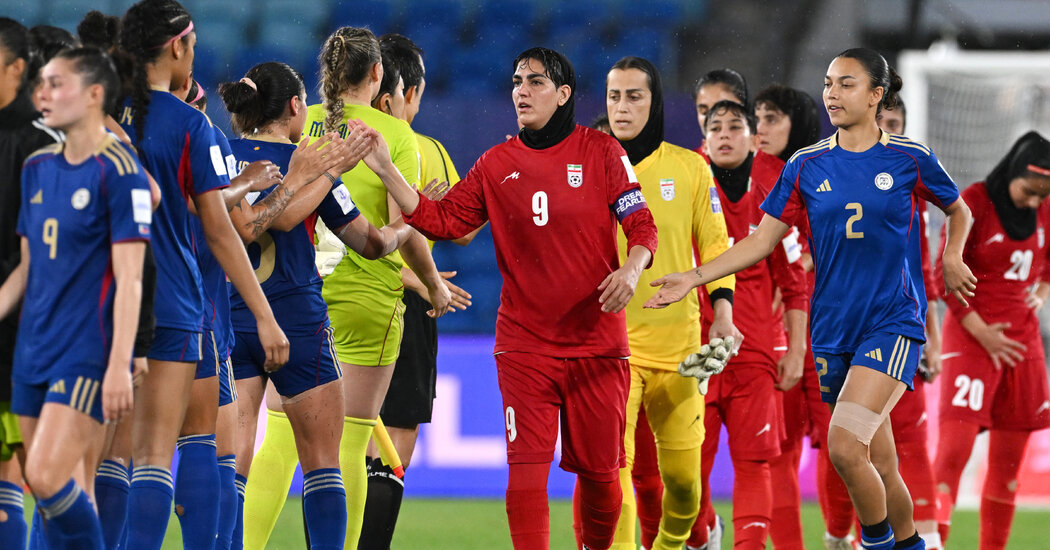
Australia has given asylum to five members of the Iranian national women’s soccer team after the players were labeled “traitors” by Iran’s state media for declining to sing their country’s national anthem at their opening game in the Asian Cup tournament.
Australia’s home affairs minister, Tony Burke, said on Tuesday that five of the 26-member squad had told the Australian authorities they wanted to remain in Australia, and that the same offer of humanitarian visas had been extended to the rest of the team.
“Australia has taken the Iranian women’s soccer team into our hearts,” the minister said.
The five women were moved to a safe location by the federal police and their applications for the visas were finalized on Tuesday morning, he added. He posted a photo on social media of himself with the five players, who were without the black hijabs they had been wearing throughout the tournament, which are mandatory for women in Iran.
Concern for the women’s safety had grown in recent days, especially after the team played its final match in the tournament in Gold Coast, Australia, on Sunday evening, and was set to return to Iran.
On Monday, President Trump weighed in on social media and said he had spoken to Prime Minister Anthony Albanese of Australia about the women’s fate. Mr. Albanese said that he fielded a call about the women from Mr. Trump just before 2 a.m. on Tuesday local time, but that the steps to offer visas to the women had been in the works for days.
“Australians have been moved by the plight of these brave women,” he said. “They’re safe here, and they should feel at home here.”
Most of the other members of the team left their hotel Tuesday afternoon and flew out of the Gold Coast airport, according to local news media. It was not immediately clear if they were headed back to Iran. Many commercial flights have been canceled because of the conflict in the Middle East.
A commentator on Iranian state television last week called for the women to be severely punished after they remained silent while the national anthem played during a game held in Gold Coast last Monday. The players sang the anthem for two matches that followed, but supporters said the women told them it was because of pressure from the Iranian government.
Players’ unions, members of the Iranian diaspora in Australia and political figures had expressed concern in recent days that the team, which arrived for the tournament before the U.S.-Israeli attacks on Iran began on Feb. 28, would face consequences upon returning to Iran.
Farhad Soheil, 38, an Iranian Australian who lives in Brisbane, said he went to the first game as a fan wanting to support the athletes but became concerned about their safety after their silence during the national anthem. He was among the crowd that rallied around the team’s bus and went to the team’s hotel on Sunday night, chanting “Save our girls,” in the hopes Australian authorities would intervene.
“That was basically the turning point,” he said. “When they decided not to sing, after that, basically we said, everyone has to go support them, they need help.”
Dayan, another member of the diaspora who asked to be only be identified by his first name out of concerns for his family in Iran, said on Tuesday that he had been outside the team’s hotel with other supporters for the past three days.
“They are champions for us,” he said. “We are proud of them. We have just one word that we can say: ‘brave.’”
Mr. Burke, the minister, said the women who opted to stay made difficult decisions and remained concerned for the safety of their family and friends back home.
“They wanted to make clear they are not political activists,” he said. “They’re athletes who want to be safe and are very grateful that Australia is making that opportunity for them.”Mr. Burke also said the players were willing to have their names and photos published. While the Australian government has not directly released their information, Reza Pahlavi, the son of Iran’s ousted shah, identified them in a social media post as forward Zahra Ghanbari, defender Atefeh Ramezanizadeh, midfielders Fatemeh Pasandideh, Zahra Sarbali and Mona Hamoudi.
Tina Kordrostami, a local lawmaker from the Sydney area, said she had been in contact with some of the players as recently as Monday. She said she had been told that one of the players had a family member detained in Iran, and another had a relative barred from leaving the country.
Australia severed diplomatic relations with Iran last year, after accusing the country’s Islamic Revolutionary Guards Corps of orchestrating at least two antisemitic attacks on Jewish institutions and businesses in Australia through proxies.
A spokesman for Iran’s Foreign Ministry, Esmaeil Baghaei, accused Australian authorities of wanting to “take our athletes hostage in the name of ‘saving’ them.”
“To Iran’s women’s football team: Don’t worry — Iran awaits you with open arms,” he said. “Come home.”