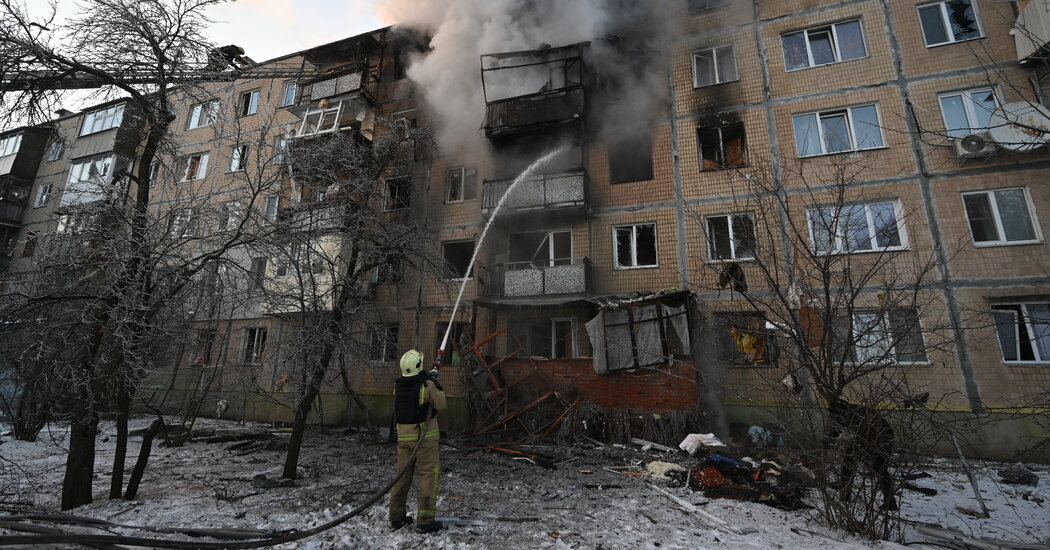
The second round of peace talks among Russian, Ukrainian and American officials began on Wednesday in the United Arab Emirates, following another huge Russian attack on Ukraine’s power grid early Tuesday.
Negotiators are expected to discuss the two main sticking points in reaching a peace deal: the fate of Ukrainian-controlled territory in the east that Russia wants, and how Ukraine’s security would be guaranteed if Russia again attacks.
Rustem Umerov, who leads Ukraine’s delegation and is the secretary of the country’s National Security Council, said on social media just before 2 p.m. in the Emirates that the closed-door talks had started.
The trilateral negotiations, first held Jan. 23 and 24 in Abu Dhabi, the capital of the Emirates, are the most public sign of progress so far in President Trump’s push to negotiate an end to the war that began with Russia’s full-scale invasion of Ukraine almost four years ago. But the two sides remain far apart.
On Wednesday, Ukraine’s foreign ministry said the Ukrainians hoped to use the new round of negotiations to understand Russia’s real intentions.
“The Ukrainian side expects these meetings to provide clarity on the feedback the Russians will bring,” Georgiy Tykhyi, a spokesman for the ministry, said in a news briefing. “After the last round, they had time to coordinate their positions with their leadership, having heard what was discussed previously and the proposals put forward by the Ukrainian side.”
The U.S. and Ukraine have agreed to potential postwar security guarantees, according to President Volodymyr Zelensky of Ukraine, although these have not been made public. But the Kremlin is deeply hostile to any arrangement that may include Western troops on Ukrainian soil.
President Vladimir V. Putin of Russia insists that as part of any peace deal, Ukraine give up not only the territory his forces have seized, but also the portion of the eastern Donetsk region that Ukraine still controls. Mr. Zelensky has said that is a non-starter.
On Wednesday, shortly after the talks began in Abu Dhabi, Russian forces shelled a market in Druzhkivka, a city still under Ukrainian control in Donetsk that faces daily bombing attacks by Russia. At least six people were killed, officials said.
A day before, Mr. Zelensky said on social media that Ukraine would shift its approach to the talks in the Emirates in light of the immense Russian bombardment of the Ukrainian power grid this week, although he did not say how.
Got a confidential news tip? The New York Times would like to hear from readers who want to share messages and materials with our journalists.
Steve Witkoff, Mr. Trump’s special envoy, held surprise meetings in Florida on Saturday with Kirill Dmitriev, the Kremlin special envoy and head of the country’s sovereign wealth fund. Details of those were not made public, although Mr. Witkoff said on social media that the meetings were “productive and constructive.”
The second round of trilateral talks was supposed to start Sunday in Abu Dhabi, but talks were postponed until Wednesday and Thursday, allowing Mr. Witkoff to attend the wedding of Dan Scavino, a White House deputy chief of staff, at Mar-a-Lago on Sunday.
Negotiations were expected to focus on a U.S.-backed 20-point peace plan that, aside from security guarantees and territorial divisions, also laid out a plan to rebuild war-ravaged Ukraine.
It is unclear how much the three sides will say publicly about specific discussions in the meetings this week. Mr. Putin’s press secretary, Dmitri S. Peskov, told reporters on Wednesday, just before the talks got underway, that the Kremlin was not planning to release any statements at the end of the day’s negotiations.
The talks come at a fraught time for Ukraine, experiencing its harshest winter in more than a decade, while Russia repeatedly targets energy infrastructure, leaving many people without heat or power.
In late January, Mr. Trump claimed to have secured from Russia an “energy truce” to suspend such attacks. But Russia simply shifted to other targets temporarily, while stockpiling weapons for a larger attack. It continued the pattern of Mr. Putin nominally addressing White House concerns, but without making concessions and continuing the war — “tapping me along,” as Mr. Trump said last year.
On Sunday, the day the Kremlin said the truce expired, Russia struck a busload of miners finishing a shift in east-central Ukraine, killing 12. And then overnight Monday into Tuesday, Russia again hammered Ukraine’s power plants, attacking them in at least six regions with 450 drones and 71 missiles, according to the Ukrainian Air Force.
That is the most Russian missiles fired into Ukraine in a single night since Christmas 2024, according to Air Force statistics compiled by The New York Times. It was also a record number of ballistic missiles fired at the power grid, Mr. Zelensky said.
He claimed that the Russians had honored the temporary energy truce “not to support diplomacy, but to simply accumulate missiles and wait for the coldest days of the year.”
On Tuesday, Mark Rutte, the secretary-general of NATO, visited Kyiv and said that the attacks did not signal Russian “seriousness about peace.”
But in Washington, Mr. Trump told reporters that Mr. Putin had “kept his word” on the temporary energy truce and said it was only supposed to last until Sunday. Mr. Trump said he wished the truce had been extended, but “we’ll take anything, because it’s really, really cold over there,” Mr. Trump said.
Oleksandra Mykolyshyn and Nataliya Vasilyeva contributed reporting.